
Airline Executive Best Starting Airport and Setup Guide
Airline Executive gives you one initial airport, one used jet, and one million dollars to begin operations across more than 1,100 real-world locations on a 3D globe. Your starting airport selection shapes initial flight range, route connections, and early cash flow.
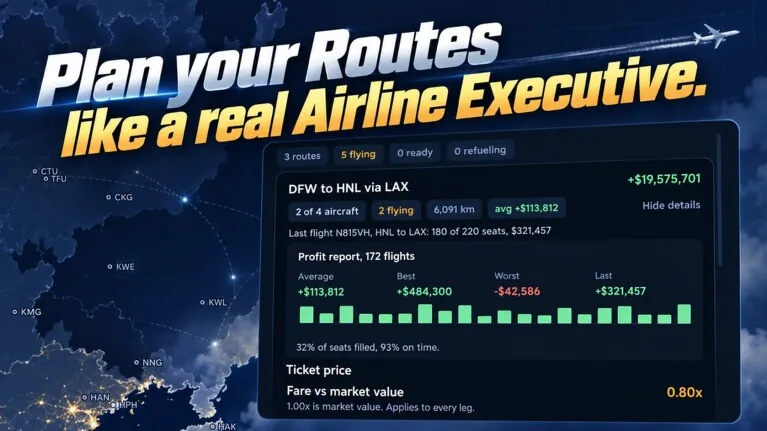
Airline Executive gives you one initial airport, one used jet, and one million dollars to begin operations across more than 1,100 real-world locations on a 3D globe. Your starting airport selection shapes initial flight range, route connections, and early cash flow.
Initial Capital and Airport Selection Rules
In Airline Executive, developed by KnotStupid Studios on Roblox, every new airline enters the simulation with identical baseline assets. The system grants one airport location, one pre-owned aircraft, and one million dollars in starting money. Because you do not begin with a sprawling network, your primary hub serves as the origin point for your first revenue flights.
The game features more than 1,100 real-world airports placed on a 3D globe. You select destinations and draw flight paths directly on the map using your mouse. Because flights operate under a 60X Simulated Time clock with active day and night cycles, aircraft travel between cities at an accelerated pace, generating rapid turnarounds and continuous operating expenses.
Starting near clusters of established cities allows you to open short routes quickly. These initial connections help generate stable cash flow before you commit funds to acquire distant destinations across overseas territories.
Balancing Hub Choices and Route Connections
Your initial location determines how efficiently you deploy used jets. Pre-owned aircraft require scheduled inspections to avoid grounding by aviation regulators. Flying excessively long overseas paths on day one increases wear and fuel consumption without guaranteeing high seat fill rates.
Ticket pricing interacts directly with your chosen hub. Setting low ticket prices fills passenger seats quickly, but narrow profit margins can leave your company vulnerable when operating costs fluctuate. Choosing a home airport surrounded by accessible regional stops gives you the flexibility to adjust fare rates while maintaining steady passenger volume.
| Early Setup Strategy | Operating Conditions | Resource Cost |
|---|---|---|
| Single-route hub flight | Running flights from your starting airport with one used jet | Requires regular maintenance to avoid regulator grounding |
| Multi-stop network route | Linking your starting hub across multiple intermediate destinations | Increases exposure to minute-by-minute fuel price shifts |
| Fleet expansion to five routes | Unlocking the First 5 Routes milestone across new airports | Demands buying airports and hiring additional pilots |
Managing Fuel and Fleet Demands from Your Hub
Operating out of any airport introduces direct exposure to changing commodity markets. In Airline Executive, fuel prices shift by the minute. If your starting airport only connects to distant, isolated terminals, sudden fuel price increases will cut into flight revenue during transit.
Shorter routes originating from dense regional clusters allow your aircraft to complete turnarounds quickly. Fast turnarounds help your balance sheet adapt to fluctuating fuel rates. Keeping flight legs manageable also lowers the immediate risk of sudden mechanical failure, helping you protect company capital while avoiding crashes or emergency regulatory intervention.
Scaling Beyond Your First Airport
Once your opening route generates positive returns, you can buy airports across other regions on the globe. Adding locations allows you to establish multi stop routes, connecting secondary destinations back to your primary hub.
Expanding past your first five routes contributes directly toward company growth milestones and net worth rankings. As your fleet grows to include new aircraft alongside older models, your initial airport remains an operational anchor for pilot scheduling, staff management, and route planning across the global server leaderboard.
Related Guides
Airport List
Review documented airport options, costs, and hub expansion mechanics across the 1,100 global destinations in Airline Executive.
Badges List
Review the complete list of official Airline Executive badges on Roblox, including testing milestones, developer encounters, and airline progression requirements.