
Airline Executive Net Worth: Leaderboard Tracking and Airline Valuation
Airline Executive net worth reflects your company's total valuation, determined by liquid cash, owned aircraft, and acquired airports across the globe. Climbing the global leaderboard requires generating flight revenue, expanding routes, and balancing maintenance costs against operational earnings.
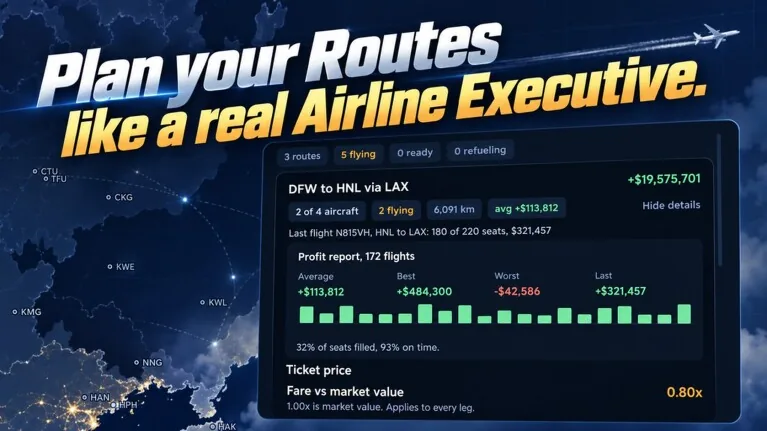
Airline Executive net worth reflects your company's total valuation, determined by liquid cash, owned aircraft, and acquired airports across the globe. Climbing the global leaderboard requires generating flight revenue, expanding routes, and balancing maintenance costs against operational earnings.
How Net Worth and Leaderboards Function
Every airline in the server operates on a visible economic playing field. The game tracks company valuation dynamically alongside fleet count, operational routes, and total airport properties. Players compete directly for spots on the global top 100 leaderboard, where standing depends entirely on company value.
Valuation increases as flights complete and deposit payouts into your balance. With the simulation operating at 60X speed, active routes continually generate capital. In gameplay footage recorded by James on YouTube, single domestic flights using older aircraft like the Boeing 737-200 generated approximately $250,000 upon landing, while extended international routes using long-range aircraft generated significantly higher income streams. As flights land and profits accumulate, your net worth reflects both your banked money and your physical assets. High-ranking accounts on the global leaderboard have recorded valuations exceeding $1.3 trillion.
Asset Investments That Build Company Value
Growing company worth from the initial baseline requires converting operating profits into capital assets. Every player starts with one airport, a single used aircraft, and $1,000,000 in starting money.
Expansion relies on two asset classes:
- Airports: You must purchase a second location to open your initial route. Regional destinations like Kansas City can be acquired for under $1.5 million, whereas major hubs like Atlanta or London Heathrow anchor larger networks. Adding regional and international locations expands route options and boosts total asset value.
- Aircraft Fleet: Fleets range from older, budget airframes to advanced long-haul aircraft. Adding models such as the Boeing 737-200, Embraer regional jets, Airbus A330, and Airbus A350 increases overall capacity and operational throughput.
| Asset Option | Best For | Capital Requirement |
|---|---|---|
| Used Regional Jet (e.g., Boeing 737-200) | Early cash generation on short domestic routes | Low initial purchase cost, requires airframe maintenance |
| Secondary Airport Hub | Establishing basic route connections between cities | Up to $1.5 million for mid-tier airports |
| Long-Haul Aircraft (e.g., Airbus A350) | High-volume intercontinental flights | Significant capital reserves, relies on established hubs |
Choosing the best aircraft for your route distances keeps planes filled and avoids unprofitable empty flights.
Protecting Margins and Reaching the Billionaire Milestone
Expanding your balance sheet involves managing operational expenses alongside route setup. Fuel costs shift on a minute-by-minute basis, meaning ticket pricing must cover overhead to prevent negative flight margins. Airplanes also experience wear, with condition percentages dropping over operational hours; failing to maintain aging planes risks intervention from regulators who ground unserviceable airframes.
Handling random company events preserves your financial momentum. Pop-up prompts that offer staff bonuses protect morale, keeping employee approval above 90% and avoiding strikes. While the financial menu provides bank loans, relying on organic flight revenue avoids recurring debt deductions against your balance.
As total valuation scales into the billions, players unlock milestone badges such as "Billionaire!", awarded specifically for reaching high valuation tiers. Maintaining active long-haul routes, reinvesting profits into aircraft, and acquiring properties across the 1,100 available real-world airports remain the direct path to sustaining multi-million and multi-billion dollar valuations.
Related Guides
Bankruptcy
Learn what triggers bankruptcy in Airline Executive and how handling maintenance, fuel spikes, and operating costs protects your carrier.
Fuel Prices
Understand shifting minute-by-minute fuel expenses in Airline Executive to adjust ticket pricing and keep your airline solvent against sudden operating spikes.